
Your technician gets the job, gets the key and clocks on. Walks out to the car park. And guess what? The car’s blocked in.
So it’s back into reception to find the keys for the other car. The clock’s running, and nothing is being sold.
The one thing your techs sell you is time. So the question I always asked was: what can I do to give my techs the best chance to sell me that time? I explain how we did it here.
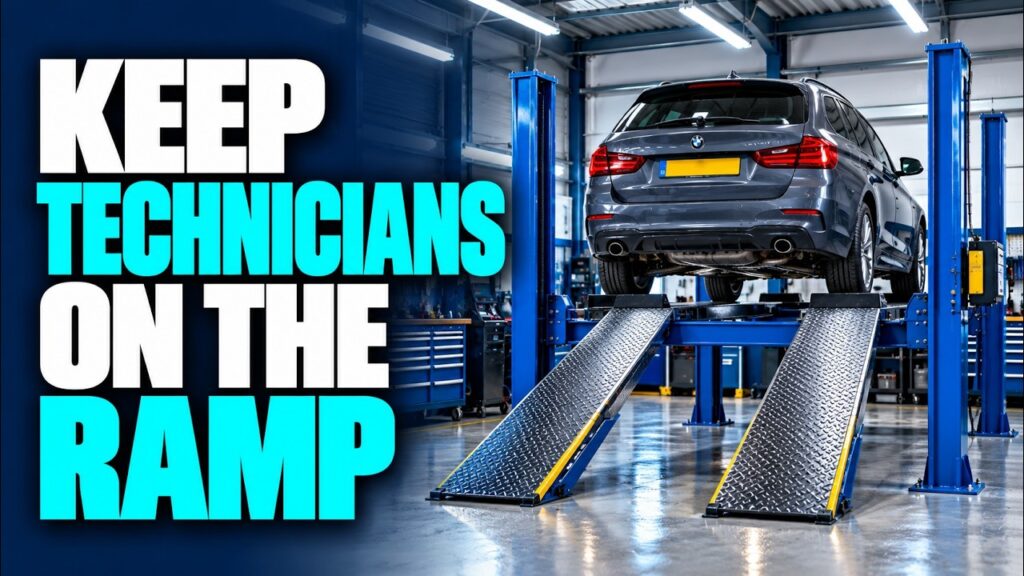
Keep them on the ramp
The key foundation is simple. Don’t make your technicians leave their ramps.
To do that, you need good processes. Every trip off the ramp, to find a key, chase a part or move a car, eats into the time you can sell.
Two runners and a production line
In my garage I had two runners. Their job was to support the workshop, and we trained them so they knew exactly what they were doing.
Front of house would see that a tech had about 15 minutes left on a car, and we’d start preparing the next job for him or her. The runners would:
- get the keys and the job card
- get the parts
- put the seat cover and floor mat in
- drive the car round and have it ready
As soon as that tech finished and clocked off, the next one was on the production line.
It worked the other way too. If the tech didn’t need to drive the finished car out or road test it, they didn’t. We’d say, “Leave it there. It’s our job.”
The maths of a runner versus a technician
Someone has to fetch the cars. The only question is who you’re paying to do it.
I’d rather have a runner getting paid £10 to £12 an hour to do that, rather than a technician who I’m paying £20 an hour to do that. The maths just don’t stack up.
Andy Savva
On wages alone, every hour of fetching a runner does instead of a tech saves you £8 to £10. And that tech is back on the ramp, doing the work you can actually charge for.
What it did for our efficiency
I’m not saying it was like that 100% of the time. You can never be 100%. But that’s where we made a huge difference.
Our efficiency rates were 90 plus per cent, consistently. It’s unheard of. Why? Because we put all these things in place.
It wasn’t only the runners. The workshop layout has a huge impact. So does the tooling. I had very specific ways of laying out the ramps, what went on them and what the benches were like. It all stemmed from the processes and foundations we laid down, and it starts at the front desk: it’s why I say front of house has the hardest job in your garage.
Where to start in your garage
- Spend a day watching how often your techs leave the ramp, and why: keys, parts, blocked-in cars, missing information on the job card.
- Decide who prepares the next job before the current one finishes, and when.
- Make keys, job card, parts, seat cover and floor mat ready before the tech clocks on.
- Look at your ramps, benches and tooling. Is everything where the tech needs it?
Then do the sum for your own garage: what you pay a tech per hour against what you’d pay someone to fetch and carry. The maths usually tells you the answer.
How healthy is your garage business?
Answer 25 questions and I’ll send you a personalised report with recommendations in seven key areas, and three practical actions you can take today. It’s free.